Back to Suffah

One of the most beautiful lessons from the story of Prophet Yaqub (عليه السلام) is that true patience does not mean giving up on what your heart longs for. It means continuing to trust Allah, even when the answer takes years.
Prophet Yaqub (عليه السلام) was separated from his beloved son Yusuf (عليه السلام) for many years. Yet, despite the passing of time, his hope in Allah never faded.
He did not allow the length of his waiting to weaken his faith. Even when his circumstances gave him no apparent reason to expect a reunion, he continued to hope in Allah's mercy.
And what a beautiful reminder his story gives us:
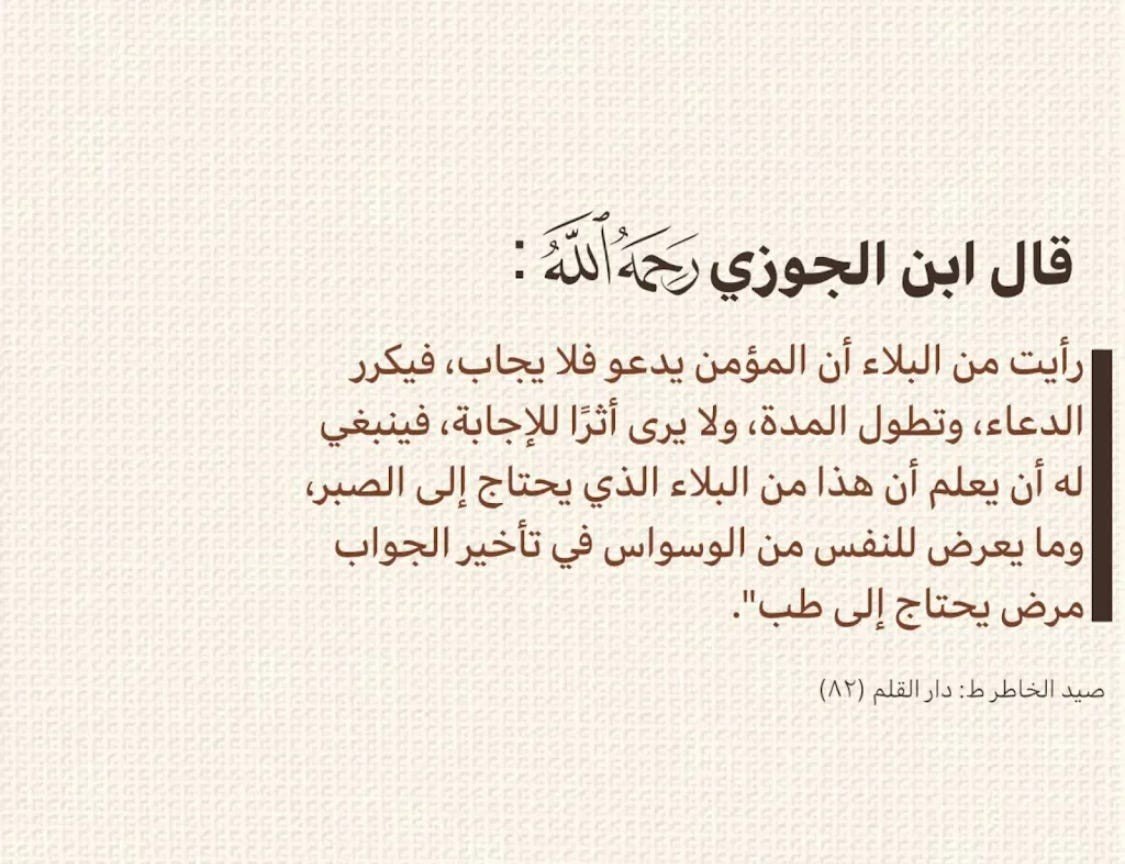
Sometimes, the same dua remains in your heart for years. You ask Allah again and again, not because you doubt Him, but because you know that only He can make it happen.
Do not mistake a delayed answer for a forgotten prayer. Do not let the passage of time convince you that your dua is impossible.
Prophet Yaqub (عليه السلام) teaches us that we can experience deep sadness and still have unwavering hope in Allah.
Keep making that dua. Keep asking with sincerity. Keep your heart attached to the One who has power over everything.
You do not know when Allah will open the door, but you can always trust the One who holds its key.
Perhaps the dua you have been making for so long will one day become the very reason your heart says Alhamdulillah.
Hazrat Yaqoob(AS) said:

Yusuf (12:87)
O my sons, go and find out about Joseph and his brother and despair not of relief from Allāh. Indeed, no one despairs of relief from Allāh except the disbelieving people." (87)
Comments · Re-Reflects

That's the book, no doubt about it—a guide for those mindful. Those upon its guidance are successful and so I strive for it. Those who strive upon its guidance will do so when the guidance is made clear for everyone to see, and so I will show patience in making the guidance clear and show patience with those who follow it when it's clear.

Those who never intended to believe will turn away when it's clear, and so I continue to strive upon patience in making clear the book in which there is no doubt.

Those who say they believe but have traded guidance for misguidance will have no patience in striving upon a book in which there is no doubt, and so I will have patience with them in seeking its guidance: I know full well that those who've traded their faith will not have patience with me in what's clear until what's hidden in them becomes clear against the book in which there is no doubt.

It's because of this that I have no need to force the religion and instead show beautiful patience in prayer, in enjoining the good and in forbidding the bad, because forcing it would blur the clear difference between belief against disbelief and hypocrisy.

Al-Baqarah (2:2)
This is the Book about which there is no doubt, a guidance for those conscious of Allāh - (2)
Al-Baqarah (2:5-6)
Those are upon [right] guidance from their Lord, and it is those who are the successful. (5) Indeed, those who disbelieve - it is all the same for them whether you warn them or do not warn them - they will not believe. (6)
Al-Baqarah (2:13)
And when it is said to them, "Believe as the people have believed," they say, "Should we believe as the foolish have believed?" Unquestionably, it is they who are the foolish, but they know [it] not. (13)
Luqman (31:17)
O my son, establish prayer, enjoin what is right, forbid what is wrong, and be patient over what befalls you. Indeed, [all] that is of the matters [requiring] resolve. (17)
Comments · Re-Reflects
Sana
7 Day ago

SubhanAllah ! The moment I read this ayah, I felt a sense of calm settle in my heart. To know that every outcome belongs to Allah. Every matter, every uncertainty, every worry and every little thing that occupies our minds day in and day out ultimately rests with Him. And He Himself tells us this. What greater reassurance could we ask for than the words of Allah Himself?

Sometimes, patience is difficult. Our minds keep wandering back to the things we are asking our Rabb for. Every few moments, we find ourselves returning to the same duas, the same hopes and the same worries. But this ayah felt like a ray of hope breaking through the darkness, reminding me that everything I am worried about already belongs to Him.

And something even more beautiful is that it isn't just about the things we verbally ask Allah for. There are desires buried deep within our hearts, wishes we haven't even found the words to express, things that never make it to our tongues but are known to Him nonetheless. We might receive something from someone only after asking, but Allah, Al-Wahhab, can bless us with things we haven't even thought to ask for. SubhanAllah. He knows what lies within our hearts, even when we remain silent.

And that is such a beautiful reason to have hope. The One who holds every outcome also knows every unspoken wish of our hearts.

May Allah grant us patience in waiting, contentment in accepting and unwavering trust in His decree. May every outcome be khayr for us, and may He bless us with things we asked for, things we forgot to ask for and even things our hearts silently longed for.Allahumma Ameen🤍

Al-Hajj (22:41)
[And they are] those who, if We give them authority in the land, establish prayer and give zakāh and enjoin what is right and forbid what is wrong. And to Allāh belongs the outcome of [all] matters. (41)
Comments · Re-Reflects

You might be the only person being kind to people with rough personalities; when no one else is.

Al-Furqan (25:20)
And We did not send before you, [O Muḥammad], any of the messengers except that they ate food and walked in the markets. And We have made some of you [people] as trial for others - will you have patience? And ever is your Lord, Seeing. (20)
Comments · Re-Reflects

In Surah Yunus ayah 89,
Allah responded ˹to Moses and Aaron˺,
“Your prayer is answered! So be steadfast and do not follow the way of those who do not know.”
And after going through the Tafseer(Tafseer e Baghvi) of this ayah, Baghvi(RA) mentioned that there was a gap of 40 years between Prophet Musa’s (AS) supplication and its fulfilment.
Now think about the patience of Prophet Musa(AS) and Harun(AS)…..
Imagine that!! Even the Prophets of Allah experienced a test of waiting.
And look at us today‼️
We make dua for something wait for a little while and when it doesn’t happen immediately we start complaining…
We question the timing of Allah.We become impatient.Sometimes we even lose hope.
But Allah teaches us through this ayah:
فَٱسْتَقِيمَا
Remain steadfast..
Never measure Allah’s care by how quickly your dua is fulfilled..
Your duty is to make dua leave the rest to Allah swt.

Yunus (10:89)
[Allāh] said, "Your supplication has been answered." So remain on a right course and follow not the way of those who do not know." (89)
Comments · Re-Reflects
S

I am a new Muslim, English speaking. Every time I read this, I am overwhelmed, I am overcome with love for Allah all the time, I want nothing more than to speak to him and pray, but I fear that praying in English is not the same. I am in the process of learning salah and have some family in Jordan helping me. Insha’allah soon I will get there I am grateful for Allah’s mercy and patience

Al-Fatihah (1:1)
In the name of Allāh, the Entirely Merciful, the Especially Merciful. (1)
Comments · Re-Reflects

Inner Peace and Remembrance (Dhikr)

• “Verily, in the remembrance of Allah do hearts find rest.”
(Quran, Surah Ar-Rad 13:28) – A reminder that true tranquility comes from connecting with the Creator.
• “Allah hears what you do not say.” – A comforting thought when words fail or prayers are silent in your heart.
Patience (Sabr) and Perseverance

• “A moment of patience in a moment of anger prevents thousands of moments of regret.” – A timeless piece of advice on emotional self-control.
• “La yukallifullahu nafsan illa wus'aha” – “Allah does not burden a soul beyond that it can bear.”
(Quran, Surah Al-Baqarah 2:286) – An assurance that every hardship matches your inner strength.
• “The bravest heart is the one that stays close to Allah, even when it's in pain.”

Gratitude (Shukr)

Comments · Re-Reflects

Inner Peace and Remembrance (Dhikr)

• “Verily, in the remembrance of Allah do hearts find rest.”
(Quran, Surah Ar-Rad 13:28) – A reminder that true tranquility comes from connecting with the Creator.
• “Allah hears what you do not say.” – A comforting thought when words fail or prayers are silent in your heart.

Patience (Sabr) and Perseverance

• “A moment of patience in a moment of anger prevents thousands of moments of regret.” – A timeless piece of advice on emotional self-control.
• “La yukallifullahu nafsan illa wus'aha” – “Allah does not burden a soul beyond that it can bear.”
(Quran, Surah Al-Baqarah 2:286) – An assurance that every hardship matches your inner strength.
• “The bravest heart is the one that stays close to Allah, even when it's in pain.”

Gratitude (Shukr)

• “If you are grateful, I will surely increase you in favor.”
(Quran, Surah Ibrahim 14:7) – Gratitude active through speech, heart, and action brings more peace.
• “Alhamdulillah for closed doors, delayed answers, and hidden protection.” – Trusting that Allah's timing is wiser than our own.

The Value of Time and Purpose

• “By time, indeed, mankind is in loss — except for those who have believed, done righteous deeds, enjoined truth, and enjoined patience.”
(Quran, Surah Al-Asr 103:1–3)
• “Return to Allah before you return to dust.” – A gentle nudge to realign your priorities before life passes by.

Comments · Re-Reflects

Choose With Faith

Yesterday, the Kuala Lumpur International Book Fair 2025 began. Being in the book circle made me feel jealous when i saw their medsos status being there. I remind myself to be patience eventhough my heart race to navigate the long highway, navigating the expected traffic jam

Being away from home and not seeing my parents, i have to put aside my desire to go shooping there. Plus, i had plan long holiday with friends and family next two week after.

Our lives will be always come to crossroads to make us making choices, whether we realize it or not

... What do we want to eat and drink today?
... What status do we want to post, like, comment?
... Who do we follow?
... Who do we want to help?
... Do we want to increase our knowledge?

And when Allah Taala lead me listen to Quran Reflect tonight, the discussion was also about making choices

MyTadabbur QS 5: 27 - 31

... A choice based on evil desires. Qabil killed his brother because his evil desires became his choice.
... A choice based on piety. Habil chose to share the truth with patience

Choices that are detrimental and bring regret. Or choices that seem to stop us from receiving the blessings of this world, but protect us from the punishment of the hereafter

... Choices that are detrimental and bring regret.

OR

... Choices that protect us from the punishment hereafter.

What are our choices today?

Make wise choices guided by faith. So that we are not being with those who exceed the limits of tyranny

---- Malay Version (Dalam Bahasa Malaysia) -----

Pilih Dengan Keimanan

Semalam bermula Pesta Buku Antarabangsa Kuala Lumpur 2025. Berada dalam 'book circle' membuatkan hati meronta-ronta untuk menelusiri lebuhraya yang panjang, meredah jem yang sudah dijangka

Dua minggu tidak balik kampung, perancangan cuti panjang pada minggu hadapan mendorong CikPidah letak tepi keinginan memeriahkan pesta buku minggu ini

Hidup kita sentiasa bertemu dengan persimpangan membuat pilihan. Sama ada sedar atau tidak, kita sentiasa perlu membuat pilihan

... Apa kita nak makan minum hari ini?
... Status apa kita nk post, like, comment?
... Siapa yang kita follow?
... Siapa yang kita nak bantu?
... Adakah kita nak tambah ilmu?

Dan apabila Allah Taala medorong CikPidah memilih untuk mendengar Quran Reflect malam ini, perbincangan jua tentang pilihan

MyTadabbur QS 5 : 27 - 31

... Pilihan yang disandarkan pada nafsu jahat. Qabil memilih untuk melayan cemburunya dengan membunuh saudaranya

... Pilihan yang dipasakkan benih ketakwaan. Habil memilih untuk kekal berpesan-pesan akan kebenaran dengan kesabaran

... Pilihan yang merugikan dan membawa penyesalan.
ATAU
... Pilihan yang kelihatan memberhentikan kita menerima nikmat dunia, namun melindungi kita dari azab akhirat

Apa pilihan kita hari ini?

Buatlah pilihan bijak yang dipandu dengan keimanan. Agar kita tidak tergolong di kalangan manusia yang melampaui batas kezaliman

26 Zulkaedah 1446, Sabtu

#AlMaidah

Al-Ma'idah (5:28)
If you should raise your hand toward me to kill me - I shall not raise my hand toward you to kill you. Indeed, I fear Allāh, Lord of the worlds. (28)
Comments · Re-Reflects
A

La patience : le remède à chaque douleur, à chaque maladie.

La patience n’est pas un état temporaire, mais plutôt une disposition constante qui soutient une personne à chaque étape de la vie. La patience est la force qui soutient un cœur brisé et apaise un esprit agité.

*Qui est Saber ?*

* Celui qui prend soin de lui-même après avoir été blessé
* Qui se concentre sur la stratégie au lieu de se plaindre
* Qui regarde le côté positif au lieu d'être pessimiste
* Il fait le meilleur usage possible de ce qu’il a.
* Qui voit la perte non pas comme un échec, mais comme un défi
* Qui, comme le Prophète Ayyub (que la paix soit sur lui), ne perd pas patience dans les moments de détresse.

La place de la patience n’est pas seulement une question de mots ; Sa valeur aux yeux d’Allah est incommensurable. Hazrat Ali (qu'Allah l'agrée) dit :

« À toute personne obéissante, il sera donné une mesure et un poids, sauf à ceux qui sont patients, car il leur sera donné une pleine mesure. »

Cette même signification est également exprimée avec plus de clarté dans ces mots :
*« Les affligés seront amenés ; on ne leur posera pas de balance, on n’ouvrira pas de registre. On les déversera sur eux, sans qu’on leur demande de compte. »*
Cette scène sera si grandiose que les peuples du monde diront avec regret :

Je souhaite! « Nos corps seraient coupés avec des ciseaux, afin que nous aussi puissions atteindre les vertus que ces patients ont atteintes. »

C'est l'endroit vers lequel pointe le Saint Coran :

*« Certes, le patient recevra sa récompense sans compter. »* (Sourate Az-Zumar : 10)
« Certes, ceux qui sont patients recevront leur récompense sans compter. »

Cette interprétation de « irresponsable » s’ouvre dans les mots de Hazrat Ali (qu’Allah l’agrée) :
Aucune mesure, aucun poids, aucun calcul, juste *donner, donner*, *verser*

❂▬๑۩۞۩๑▬▬▬❂

Az-Zumar (39:10)
Say, "O My servants who have believed, fear your Lord. For those who do good in this world is good, and the earth of Allāh is spacious. Indeed, the patient will be given their reward without account [i.e., limit]." (10)
Comments · Re-Reflects
H

La piété ne s’exprime pas seulement à travers les actes d’adorations. Elle s’exprime également à travers la patience et le bon comportement pendant les épreuves.

Rester obéissante à Allah, tenir bon, continuer les actes qui nous rapproche de lui et maintenir une bonne image et relation avec lui malgré l’épreuve c’est ça « surtout » faire preuve de piété.

Et ceux même lors d’épreuve « positive » : ou Allah t’accorde ses faveurs et ce que tu désires. Rester proche de lui et ne pas laisser cette choses te distraire de son rappel et de son obéissance, te rappeler que tout cela vient de lui et qu’il peut le reprendre à tout moment.

Al-Baqarah (2:177)
Righteousness is not that you turn your faces toward the east or the west, but [true] righteousness is [in] one who believes in Allāh, the Last Day, the angels, the Book, and the prophets and gives wealth, in spite of love for it, to relatives, orphans, the needy, the traveler, those who ask [for help], and for freeing slaves; [and who] establishes prayer and gives zakāh; [those who] fulfill their promise when they promise; and [those who] are patient in poverty and hardship and during battle. Those are the ones who have been true, and it is those who are the righteous. (177)
Comments · Re-Reflects
ناس
1 Year ago

Reflexion sur le cœur et l’ouïe

Pas une journée ni une nuit d’été ne passe sans que mon œil, mon oreille, ma
langue ou mes membres ne ressentent les signes d’Allah, m’amenant à des
réflexions et méditations. Parfois, elles portent sur le même thème (le soleil, la
chaleur, la patience...), mais à un détail près, elles ciblent des dimensions
différentes.

Lorsque l’on se pose sur un signe d’Allah, ouvrant son cœur, ses membres, son
âme, appréciant le silence d’un moment ou d’une scène, cela nous pousse à
réfléchir.

J’aimerais partager une réflexion que j’ai eue concernant le Qur’an et son
écoute. L’écoute du Qur’an agit sur le cœur : elle l’atteint ou non, selon l’opacité
de ce qui le recouvre, comme péchés ou maladies.

Parmi les effets d’une récitation, tant du point de vue de l’auditeur que du
lecteur, on retrouve l’élargissement de la poitrine, l’apaisement du cœur, l’esprit
qui navigue dans des contrées plus hautes, le monde qui se coupe, la vie qui se
prolonge… Il s’agit d’une expérience à part.

Une de mes expérience personnelle de l’écoute consiste au fait que je tende
l’oreille à la récitation et que j’essaie d’entendre les règles du tajwid, d’affiner mes
sens, dans le but de mieux comprendre et de me corriger.

Mais je me suis rendue compte qu’à certains moments, je n’écoute pas cette
parole divine, ni avec mes membres, ni avec mon cœur, mais avec un mur qui
fait obstacle. Comme un voile qui viendrait empêcher la pénétration (tant
physique que métaphysique) du Qur’an. J’ai alors compris qu’un effort
physique et psychique devait être fait afin de pouvoir accueillir le Qur’an : créer
une connexion et s’ouvrir dans tous les aspects.

Parfois, en tant que professeur ou personne qui corrige la récitation de
quelqu’un, on entend certaines choses que d’autres n’entendent pas. Et cela
donne un sentiment particulier, presque celui d’avoir été choisi pour percevoir
ces subtilités.

Non pas dans une logique d’égo ou de supériorité, mais plutôt comme une
prise de conscience de la finesse de l’écoute, et de ce que cela demande
comme précision.

Dans la récitation du Qur’an, il y a des choses que l’on entend qui relèvent du
détail : la ghounnah, l’itbaq, l’ikhfa… des sons et des placements qu’il faut
savoir écouter et surtout percevoir.

C’est comme si, à travers le tajwid, on redécouvrait son propre corps. On
pousse ainsi nos capacités à l’extrême : notre ouïe, notre bouche, notre
souffle... On apprend à placer notre langue, nos lèvres, notre gorge… à
reconnaître à quel niveau on se situe.

C’est une forme de maîtrise, un certain niveau qu’on n’aurait pas atteint
autrement. Être apprenant du Qur’an implique un dépassement de soi,
dans ses capacités et dans ce qu’Allah nous a accordé comme sens et ressources.

Depuis lors, j’ai pris conscience du don qu’Allah a placé dans mon ouïe et ma
vue. Et je ne me contente plus de tendre l’oreille quand j’écoute, plutot, je les
ouvre et les fais 'travailler'

C’est comme si j’actionnais un levier, demandant la permission à Allah
d’exploiter au maximum mes ressources auditives et visuelles quand je suis
face à une personne qui me récite.

J’appelle ça l’ouverture.

Qaf (50:37)
Indeed in that is a reminder for whoever has a heart or who listens while he is present [in mind]. (37)
Comments · Re-Reflects
A

La patience : le remède à chaque douleur, à chaque maladie.

La place de la patience n’est pas seulement une question de mots ; Sa valeur aux yeux d’Allah est incommensurable. Hazrat Ali (qu'Allah l'agrée) dit :

« À toute personne obéissante, il sera donné une mesure et un poids, sauf à ceux qui sont patients, car il leur sera donné une pleine mesure. »

Az-Zumar (39:10)
Say, "O My servants who have believed, fear your Lord. For those who do good in this world is good, and the earth of Allāh is spacious. Indeed, the patient will be given their reward without account [i.e., limit]." (10)
Comments · Re-Reflects

Surah Yusuf teaches us that not every delay is a denial, and not every pain is a punish-ment. Sometimes, Allah is unfolding a plan so delicate that it requires time, patience, and complete trust. Yusuf (AS) was betrayed, abandoned, and forgotten in places where no one would expect ease to come, yet every moment was leading him exactly where he was meant to be. What looked like loss was protection. What felt like silence was divine planning. There will be phases in your life where nothing makes sense, where your duas feel unanswered, and where your heart feels heavy with questions. But Surah Yusuf reminds us that Allah is never absent
He is aligning things in ways you cannot see.

Yusuf (12:87)
O my sons, go and find out about Joseph and his brother and despair not of relief from Allāh. Indeed, no one despairs of relief from Allāh except the disbelieving people." (87)
Comments · Re-Reflects

Sometimes, certain situations make a woman understand why Prophet Muhammad ﷺ became so emotional while reminding the Ummah in his Last Khutba:
“Fear Allah regarding women.”
There are moments when a woman’s silence is mistaken for weakness, her patience is taken for granted, and her kindness is met with hurt.
But we forget that every woman is someone’s daughter, sister, wife, or mother — and above all, she is a servant of Allah whose rights must be respected.

Allah says:
وَعَاشِرُوهُنَّ بِالْمَعْرُوف
“And live with them in kindness.”
— Surah An-Nisa (4:19)

Fear Allah in the way you treat women. Their dignity, feelings, and rights are an Amanah.

An-Nisa (4:19)
O you who have believed, it is not lawful for you to inherit women by compulsion. And do not make difficulties for them in order to take [back] part of what you gave them unless they commit a clear immorality [i.e., adultery]. And live with them in kindness. For if you dislike them - perhaps you dislike a thing and Allāh makes therein much good. (19)
Comments · Re-Reflects