Back to Suffah
cin
1 Day ago

Zuhd. Detachment from this world. In Islamic thought, it is not about living in poverty, or living in worn down clothes, or completely abandoning society; it is a state of heart.

Money, a relationship, a title, a plan you had in mind—all of it is borrowed, and we don't own any of it. Sometimes, I unknowingly attach myself to things that may collapse overnight by Allah's Will. A person that could leave, money that could run out, and plans that could be eventually broken. Every time one of those things changed, my inner state changed as well. I depended on something that was never stable to begin with.

Zuhd isn't about hating this dunya or owning nothing. The Prophet (SAW) had a wife, a home, and companions he loved deeply, but he wasn't detached from people; he was attached to Allah first. How beautiful is that? That is the real change. Not loving less, but to love in the right way. Love Allah first, every thing else after, not "instead of." So when I notice that something I love begins to control my mood, my peace, my worship, I'll pause and ask: "Am I attached to this, or attached to Allah through this?"

I saw a Tiktok that said to practice telling yourself "This is a means, not the source." about the things I love. The person, the job, the money. Allah is the very source of every thing. When you lost something that you were attached to, let the grief linger for a bit, but redirect the question. It is not "Why did I lose this?" but "What is this teaching me about where I placed my heart?" Every single thing in this world has an expiration date. People come and go. Money runs out. Plans will fall apart. But Allah doesn't. Real peace comes from attachment to Allah, and it is the only attachment that will last forever. So next time when I am eventually blessed with something, I'll try my best to attach myself to Allah to be able to love every blessing with no strings attached.

Al-'Ankabut (29:64)
And this worldly life is not but diversion and amusement. And indeed, the home of the Hereafter - that is the [eternal] life, if only they knew. (64)
Comments · Re-Reflects

In the Name of Allah, the Most Merciful, the Especially Merciful,

I have four children, three attend Islamic school and the eldest I homeschool. He is 13 and every Friday I teach him a chapter of the seerah and this week I started with Tafsir (by Dr Mustafa Al Khattab).

Countless of times since my children were small we have visited Suratul Fatiha. So, I was slightly worried my son knows about Suratul Fatiha and I have done this repeatedly. As a teenager he could lose some interest.

But, I decided to make Suratul Fatiha exclusively about my son. So we reflected that Suratul Fatiha begins by praising Allah and truly Allah is the Bestower of every blessing we can count and for the ones we are unable to count. I also told him to say ‘el hamdulillah’ together not only for the blessings but the internal things we are dealing with. El hamdulillah for the adhd, el hamdulillah for the way my brain is designed and that Allah loves you, yes you. He designed you not with any error but in the form He wants so that you can be close to Him. Allah wants you to have a positive mindset and with Him you will find love and acceptance. Thus, He tells us He is the Most Merciful, the Especially Merciful.

A mother’s love is huge (and a father’s) but God’s love is vaster than that. We took one lesson from our preliminary study and that is to have a positive and grateful mindset throughout our lives.

Reciting Suratul Fatiha 17 times a day should remind you and me of keeping a positive mindset about Allah.

I hope this reflection might help someone as it helped our hearts. I could see my son’s eyes light up knowing he is so loved by Allah just as He loves all of us.

Al-Fatihah (1:1-4)
In the name of Allāh, the Entirely Merciful, the Especially Merciful. (1) [All] praise is [due] to Allāh, Lord of the worlds - (2) The Entirely Merciful, the Especially Merciful, (3) Sovereign of the Day of Recompense. (4)
Comments · Re-Reflects
Abdul Wadud @abdulwadud
Nov 1
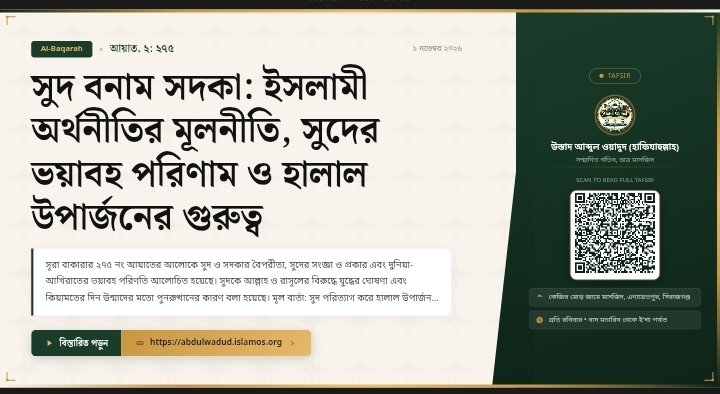
তাফসির, সূরা বাকারা, ২:২৭৫; আলোচ্য বিষয়: সুদ বনাম সদকা: ইসলামী অর্থনীতির মূলনীতি, সুদের ভয়াবহ পরিণাম ও হালাল উপার্জনের গুরুত্ব। এই আয়াতের আলোকে সুদ ও সদকার বৈপরীত্য, সুদের সংজ্ঞা ও প্রকার এবং দুনিয়া-আখিরাতের ভয়াবহ পরিণতি আলোচিত হয়েছে। সুদকে আল্লাহ ও রাসূলের বিরুদ্ধে যুদ্ধের ঘোষণা এবং… Show more
islamos.org তাফসির, সূরা বাকারা, ২:২৭৫; আলোচ্য বিষয়: সুদ বনাম সদকা: ইসলামী অর্থনীতির মূলনীতি, সুদের ভয়াবহ পরিণাম ও হালাল উপার্জনের গুরুত্ব - Article | iSLamOS উস্তাদ: মুফতি আব্দুল ওয়াদুদ হাফিজাহুল্লাহ, সম্মানিত খতিব, কেজির মোড় জামে মাসজিদ, এনায়েতপুর, সিরাজগঞ্জ।সংক্ষিপ্ত স্ক্রিপ্ট: মোহাম্মদ কাউছার আহমাদ সম্রাট।তাফসির, সুরা বাকারা, ২:২৫৫; আলোচ্য বিষয়: আয়াতুল […]
0 0 45